The Silent Killer in Your Backyard: The Ultimate Guide to Dog Heartworm Prevention
Imagine your dog—your best friend, your shadow, the one who greets you with a wagging tail every single day—is harboring a foot-long parasite inside their heart. It sounds like something out of a horror movie, yet for hundreds of thousands of dogs every year, heartworm disease is a terrifying reality.
Often called “The Silent Killer,” heartworm disease is a slow-growing, devastating condition that can go undetected for months or even years. By the time symptoms appear, the damage to the heart, lungs, and arteries is often irreversible. But here is the good news: heartworm is almost 100% preventable.
In this comprehensive guide, we are going to dive deep into the biology of heartworms, the high cost of neglect, the myths that put dogs at risk, and the simple steps you can take today to ensure your pup lives a long, heartworm-free life.
1. Understanding the Enemy: What Exactly is Heartworm?
Before we can fight it, we have to understand what it is. Heartworm disease is caused by a parasitic worm called Dirofilaria immitis. These aren’t just tiny organisms; adult heartworms look like thick strands of spaghetti and can grow up to 12 inches in length.
The Life Cycle of a Nightmare
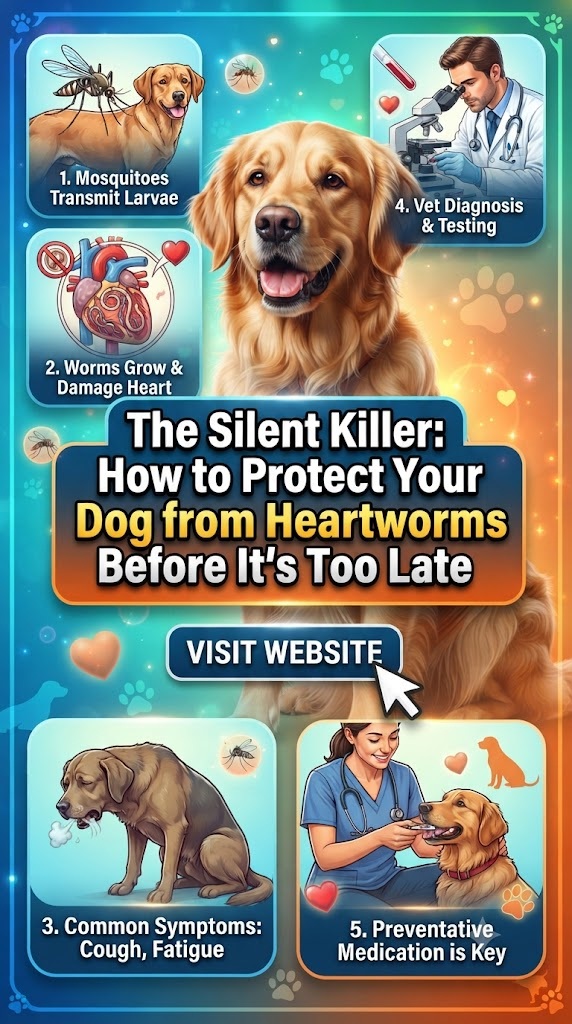
The journey of a heartworm is a complex, biological relay race that requires two specific hosts: the mosquito and the dog.
- The Bite: A mosquito bites an infected animal (a dog, coyote, fox, or wolf) and picks up tiny baby worms called microfilariae.
- The Incubation: Inside the mosquito, these microfilariae develop into “infective stage” larvae over the course of 10 to 14 days. This only happens when the weather is warm enough.
- The Transmission: That same mosquito bites your dog, leaving the larvae on the skin. The larvae then crawl into the bite wound and enter the dog’s body.
- The Migration: Over the next 6 months, these larvae migrate through the dog’s tissues, eventually reaching the heart and pulmonary arteries.
- The Maturation: Once they reach the heart, they mature into adults, mate, and start producing their own microfilariae, continuing the cycle.
A single dog can be home to dozens, or even hundreds, of these worms. They live for 5 to 7 years in dogs, and because they reside in the heart and lungs, they cause physical blockages and massive inflammation.
2. Why “One Bite” is All It Takes
Many pet owners believe that if their dog stays indoors or if they live in a “low-risk” area, they don’t need to worry. This is one of the most dangerous misconceptions in pet care.
The Indoor Dog Myth
Mosquitoes do not respect doors or window screens. In fact, studies show that a significant percentage of heartworm-positive dogs are described by their owners as “strictly indoor pets.” All it takes is one mosquito getting through the door while you’re carrying groceries, or one quick bathroom break at dusk, for transmission to occur.
The “Too Cold” Fallacy
While it’s true that mosquitoes are more active in the summer, climate change and urban “heat islands” have made heartworm a year-round threat. Mosquitoes can survive in crawl spaces, sewers, and garages even during the winter. Furthermore, if you miss just one month of prevention because you thought it was “too cold,” you leave a window wide open for infection.
3. The Four Stages of Heartworm Disease
Heartworm is insidious because it starts off invisible. Veterinarians categorize the disease into four stages:
Stage 1: The Asymptomatic Phase
At this point, the dog looks and acts completely normal. The worms are still maturing. Most cases are caught here only through routine annual blood testing.
Stage 2: Mild Symptoms
The dog may show a lingering cough or tire more easily after a walk. They might seem a bit “off,” but many owners mistake this for the dog just getting older or having a lazy day.
Stage 3: Severe Disease
This is where the situation becomes critical. The dog’s appearance changes. They may have a persistent cough, labored breathing, and a “pot-bellied” appearance due to fluid buildup in the abdomen. Their chest might look puffed out as the heart enlarges to try and pump blood past the mass of worms.
Stage 4: Caval Syndrome
This is a life-threatening emergency. The mass of worms is so thick that it physically blocks blood flow back to the heart. Symptoms include sudden collapse, pale gums, and dark brown or red urine. Surgery is the only option at this stage, and even then, the prognosis is guarded.
4. The Economics of Prevention vs. Treatment
If the health of your dog isn’t enough to convince you, perhaps the financial reality will. Heartworm prevention is one of the most cost-effective investments a pet owner can make.
The Cost of Prevention
Most monthly preventatives cost between $10 and $20 per month. Over the course of a year, you might spend $150 to $200. This often includes protection against other parasites like hookworms, roundworms, and sometimes fleas and ticks.
The Cost of Treatment
Treating a dog that is already heartworm-positive is a grueling, expensive process.
- The Cost: Treatment usually starts at $1,500 and can easily climb to $3,500+ depending on the dog’s size and the severity of the case.
- The Physical Toll: The treatment involves multiple injections of an arsenic-based drug (Melarsomine) into the deep muscles of the dog’s back. It is painful and can cause severe side effects.
- The Restriction: During treatment (which lasts several months), the dog must be kept under strict crate rest. No running, no jumping, and no excitement. If the dog’s heart rate spikes, the dying worms can break apart and cause a fatal pulmonary embolism (clogged artery in the lungs).
When you look at the numbers, you could pay for 15 to 20 years of prevention for the cost of a single treatment.
5. Navigating Prevention Options: Which is Right for Your Dog?
Modern medicine has given us incredible tools to stop heartworms before they start. Here are the three main ways to protect your pup:
Oral Chewables (Monthly)
These are the most common. Brands like Heartgard Plus, Interceptor Plus, and Simparica Trio are highly effective.
- Pros: Easy to give at home; often flavored like a treat; usually covers intestinal parasites.
- Cons: You have to remember to give it every 30 days. If you are even a few days late, your dog is at risk.
Topical Solutions (Monthly)
Applied to the skin at the back of the neck, brands like Revolution or Advantage Multi are great for dogs who are picky eaters.
- Pros: Protects against fleas, ear mites, and some ticks alongside heartworms.
- Cons: Can be messy; requires the dog to stay dry for a certain period after application.
The “Set It and Forget It” Injectable
ProHeart 6 or ProHeart 12 is an injection given by your veterinarian that provides continuous protection for 6 or 12 months.
- Pros: Eliminates the risk of owner forgetfulness. It is the gold standard for busy families.
- Cons: Must be administered by a vet; doesn’t usually cover as many intestinal parasites as the oral options.
6. Debunking “Natural” Heartworm Remedies
In the age of social media, “natural” and “holistic” pet care advice is everywhere. While wanting to reduce chemicals in your dog’s life is an admirable goal, heartworm is one area where “natural” can be deadly.
The Garlic Myth
Some claim that feeding garlic to dogs will make their blood “unpalatable” to mosquitoes. There is zero scientific evidence to support this. Furthermore, garlic in large quantities can be toxic to dogs, causing oxidative damage to red blood cells.
Essential Oils
Citronella, cedar, and peppermint oils can repel mosquitoes to some degree, but they are not 100% effective. Even a 95% effective repellent leaves a 5% chance of infection. In the world of heartworms, 95% is a failing grade.
The Truth About “Chemicals”
The active ingredients in heartworm preventatives are used in incredibly small doses. They are designed to clear out any larvae that entered the dog’s system in the previous 30 days. They don’t stay in the dog’s bloodstream for long. Compared to the “chemical” used in treatment (arsenic), prevention is incredibly mild and safe.
7. The Crucial Role of Annual Testing
You might wonder: “If my dog is on prevention year-round, why do I still need to pay for a test every year?”
This is a common frustration for pet owners, but the annual heartworm test is a safety net for several reasons:
- Human Error: We all miss a dose sometimes. Maybe the dog spit the pill out behind the sofa, or you gave it three weeks late.
- Product Failure: While rare, no medication is 100% effective. Early detection via a test can save the dog’s life before the worms cause damage.
- Safety First: Giving heartworm prevention to a dog that already has an active, heavy heartworm infection can be dangerous. The rapid die-off of microfilariae can cause an anaphylactic-like shock reaction.
The test is a simple blood draw that takes minutes. Think of it as your “all clear” for another year of safety.
8. Breed Sensitivities: The MDR1 Mutation
For owners of Herding breeds—like Australian Shepherds, Collies, and Shetland Sheepdogs—there is an extra layer of caution needed. Some of these dogs carry the MDR1 (Multi-Drug Resistance) gene mutation, which makes them sensitive to certain medications, including high doses of ivermectin.
However, the dose of ivermectin in standard heartworm preventatives is so low that it is generally considered safe even for MDR1-positive dogs. Regardless, if you own a herding breed, always consult with your vet about the safest specific brand for your dog’s genetic makeup.
9. Global Trends: Is Heartworm Getting Worse?
Veterinary experts are seeing a rise in heartworm cases across North America and Europe. Why?
- Pet Relocation: When we rescue dogs from high-risk areas (like the American South) and ship them to “low-risk” areas (like the Pacific Northwest or New England), we inadvertently bring the parasite into new mosquito populations.
- Urbanization: Cities create heat. Retaining heat during the night allows mosquitoes to survive and incubate larvae in regions where they previously couldn’t.
- Wildlife Reservoirs: Coyotes and foxes act as “reservoirs” for the disease. As urban sprawl moves into wildlife habitats, the bridge between wild animals and domestic pets shortens.
10. A Checklist for the Responsible Dog Owner
To ensure your dog never has to face this “Silent Killer,” follow this simple checklist:
- Test Every 12 Months: Never skip the annual blood test.
- 12 Months of Protection: Don’t stop in the winter. The easiest way to remember is to do it on the same day every month (e.g., the 1st).
- Environmental Control: Minimize standing water in your yard (birdbaths, clogged gutters, flower pots) where mosquitoes breed.
- Watch for Symptoms: If your dog develops a persistent cough or tires easily, see a vet immediately, even if they are on prevention.
- Keep Records: Keep your receipts and boxes. Many heartworm medication manufacturers offer a “guarantee”—if your dog tests positive while on their product, they may pay for the treatment.
The Bottom Line: Love Means Prevention
Our dogs rely on us for everything—their food, their shelter, and their health. They can’t tell us when a mosquito has passed a deadly parasite into their bloodstream. They can’t tell us that their heart is struggling to pump.
Heartworm disease is a tragic, painful, and expensive ordeal, but it is also one of the most preventable diseases in the veterinary world. By choosing a monthly chewable, a topical, or a yearly injection, you aren’t just buying medicine; you’re buying peace of mind. You’re ensuring that the “Silent Killer” stays far away from your backyard, allowing your best friend to keep wagging their tail for years to come.
Don’t wait for the symptoms. Don’t wait for the “mosquito season.” Protect your dog today.